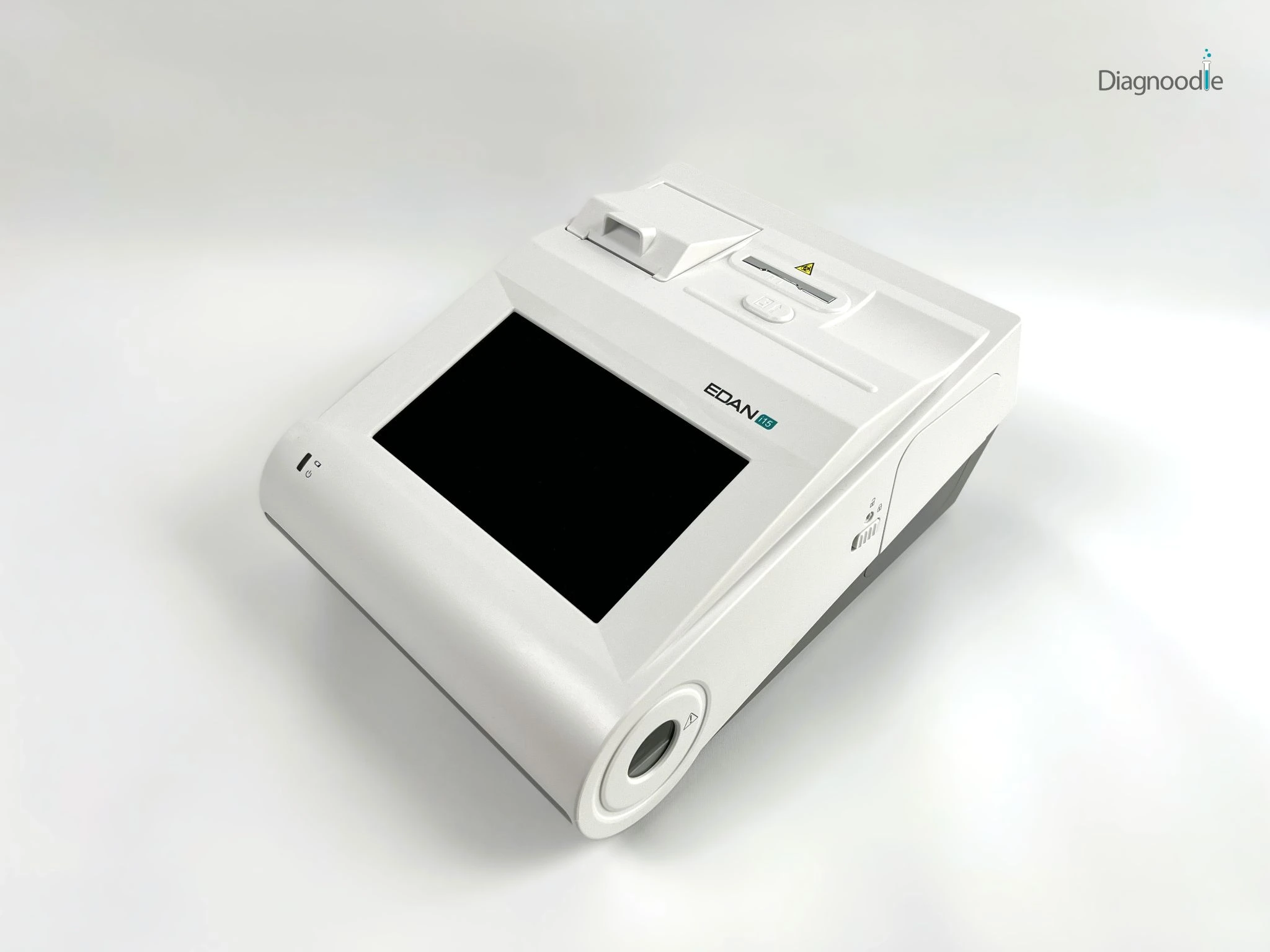

RAPIDPoint 500e
Das RAPIDPoint 500e ist ein stationäres Blutgasanalysesystem für kritische klinische Bereiche mit Bedarf an schneller, präziser Diagnostik. Es liefert Ergebnisse für Blutgase, Elektrolyte, Metabolite, Co-Oximetrie und neonatales Gesamtbilirubin in etwa 60 Sekunden. Durch automatisierte Qualitätskontrollen, wartungsfreie Kassettentechnologie und integrierte Datensicherheitsfunktionen eignet sich das System für Notaufnahmen, Intensivstationen, perioperative Arbeitsbereiche und Einrichtungen mit anspruchsvollen POC-Diagnostikprozessen.
Das RAPIDPoint 500e arbeitet mit einer planarbasierten Sensorkassette, die alle Messfunktionen inklusive CO-Oximetrie, Probennehmer und Reaktionsfelder enthält. Die Kassette wird alle 28 Tage oder nach Erreichen der maximalen Testanzahl ausgetauscht. Das Gerät analysiert Vollblut, Pleuraflüssigkeit und Dialysat (regional abhängig) und benötigt 100 µL Probenvolumen. Gemessen werden pH, pCO2, pO2, Natrium, Kalium, ionisiertes Kalzium, Chlorid, Glukose, Laktat, Hämoglobin, Sauerstofffraktionen sowie neonatales Gesamtbilirubin. Berechnete Parameter umfassen HCO3-act, HCO3-std, ctCO2, Basenabweichung, pO2/FiO2 und weitere Säure-Basen- und Oxygenierungsgrößen. Die Integri-sense Technologie führt Funktionsprüfungen und Probenintegritätschecks vor, während und nach jeder Analyse durch. Die Datenübertragung erfolgt über HL7, POCT1-A, LAN, WLAN oder RS232, ergänzt durch eine integrierte Firewall, verschlüsselte Datenübertragung und McAfee Anti-Malware. Ein Touchdisplay ermöglicht die vollständige Steuerung des Systems.
- Notaufnahmen und Schockräume mit hoher zeitkritischer Diagnostik
- Intensivstationen und Intermediate-Care-Bereiche
- Neonatologische Versorgung mit Bedarf an bilirubinbezogenen Messungen
- OP-nahe perioperative Diagnostik
- Dialyseabteilungen für Zusatzanalytik (regional abhängig)
- POC-nahe Arbeitsplätze mit zentralem Datenmanagement über POCcelerator/RAPIDComm
- Sofortige Blutgasdiagnostik zur Beurteilung des respiratorischen Status
- Elektrolytmonitoring bei metabolischen Entgleisungen oder Intensivtherapie
- Laktatbestimmung zur Einschätzung von Perfusionsstörungen und Schock
- Hb- und Co-Oximetrie-Analysen zur Abklärung von Hypoxien oder Vergiftungen
- Neonatale Bilirubinbestimmung zur Identifikation therapiepflichtiger Hyperbilirubinämien
- Pleura-pH-Analyse zur Differenzierung infektiöser oder komplizierter Ergüsse
- Unterstützung bei Beatmungseinstellungen über erweiterte berechnete Parameter
- Ergebnisse in etwa 60 Sekunden für alle Messparameter
- Wartungsfreie Kassettentechnologie reduziert Bedienaufwand und Ausfallzeiten
- Probenapplikation kontaktlos durch automatische Aspiration
- Geringes Probenvolumen von nur 100 µL
- Umfassende Sicherheitsfunktionen: Datenverschlüsselung, Firewall, Malware-Schutz
- Drei Ebenen unabhängiger automatischer QC-Materialien
- Nahtlose LIS/HIS-Anbindung sowie WLAN-Option
- Hohe Betriebssicherheit durch Integri-sense Funktionsprüfungen
- Unterstützt Spritzen- und Kapillarproben ohne Adapter
Im Vergleich zu klassischen stationären Blutgasgeräten kombiniert das RAPIDPoint 500e ein breites Parametermenü mit minimaler Wartung, da alle Sensoren und Reaktionsfelder mit der Kassette erneuert werden. Gegenüber kleineren POCT-Geräten bietet es vollständige Co-Oximetrie, neonatalen Bilirubinparameter, integrierte IT-Sicherheitsfunktionen und eine konsistente Qualitätskontrolle über mehrere Ebenen. Die automatische, kontaktlose Probenaspiration reduziert Anwenderfehler, während die WLAN-Option eine flexible Integration in bestehende IT-Strukturen ermöglicht. Die Analysezeit von etwa 60 Sekunden liegt im Bereich größerer Geräte, bei deutlich reduziertem Bedienaufwand und höherer Prozessautomatisierung.
Parameterübersicht
Es ist möglich, dass bestimmte berechnete Parameter nicht angegeben sind.
Testübersicht (1)
RapidPoint 500e
RapidPoint 500e
Studien & Produktdokumente
The RAPIDPoint 500 BGA provides highly reliable CSF lactate measurements with excellent inter-rater agreement. Despite a small systematic bias, the analyzer's speed and accuracy support its use as a valuable POCT solution for the timely diagnosis of acute meningitis in clinical settings.
"Haemolysis causes negative influence with sodium measured by both indirect and direct ion-selective electrode due to a dilutional hyponatremia. The additional interference in indirect ion-selective electrode is due to the electrolyte exclusion effect but this is unlikely to be clinically significant as it is small in magnitude."
KI-Zusammenfassung
Die vorliegenden Vergleichsstudien zeigen ein differenziertes Bild zur Leistungsfähigkeit des RapidPoint 500 in verschiedenen klinischen Szenarien. In direkten Vergleichen mit Geräten wie dem ABL90, GEM 4000 oder dem RapidLab 1265 sowie verschiedenen Handheld-Systemen (epoc, portable BGA) erweist sich das RapidPoint 500 grundsätzlich als verlässliches Referenzsystem für Notfallstationen und Intensivmedizin. Es zeigt eine hohe Präzision und starke Korrelationen bei Blutgasen, Elektrolyten und der CO-Oximetrie. Dennoch offenbaren die Studien spezifische Limitationen: Unter extremen Bedingungen in großen Höhen (4.559 m) sank die Zuverlässigkeit im Vergleich zum ABL90, wobei das RapidPoint 500 häufiger unvollständige Variablensätze lieferte. Zudem können bei Patienten mit schwerer Hypernatriämie signifikante Abweichungen zwischen dem RapidPoint 500, dem ABL90 und dem GEM 4000 auftreten. Während mobile Systeme wie das epoc-System für den schnellen Einsatz in der Intensivmedizin bei den meisten Parametern als klinisch adäquat bewertet werden, bleibt das RapidPoint 500 ein etablierter Standard, sofern keine extremen Umweltbedingungen oder spezifische Elektrolytentgleisungen vorliegen, die eine laborchemische Bestätigung erfordern.
"In this study, the reliability of RAD [ABL90] was superior to SIE [Rapidpoint 500] at nSL423 and HA4,559. In contrast to RAD, the performance of SIE declined at HA4,559. SIE was more prone to not reporting all variables, especially at HA4559."
"In severe hypernatremia, sodium results produced by blood gas and plasma analyzers [ABL90, RAPIDPoint 500, and GEM 4000] can differ significantly."
"Accuracy of blood gas analysis by the portable BGA in comparison to the reference BGA [RapidPoint 500]was adequate for clinical use. Because of portability and ease of handling, portable BGA are valuable diagnostic tools for use in everyday practice as well as under challenging field conditions."
The epoc® system is fit for use in surgical and ICU settings, showing high accuracy for blood gases, electrolytes, lactate, and glucose [compared to the RAPIDPoint 500] and for hematocrit/hemoglobin [compared to HemataSTAT-II and Sysmex XN-10]. However, it is not recommended for renal assessment due to a significant positive bias in creatinine [compared to Abbott Architect c8000 and Roche Cobas c702]. This bias leads to inaccurate eGFR calculations and inconsistent CKD staging, requiring laboratory confirmation for clinical decisions.
"With most of the measured blood gas parameters, the epoc analyzer correlated well with reference techniques [Siemens Rapidlab 1265 and Rapidpoint RP500 and Siemens Dimension Vista and Sysmex XE-2100 analyzers]. The epoc analyzer is suitable for rapid measurement of the blood gases, the electrolytes, and the metabolites in the ICU."
The RapidPoint 500® demonstrates excellent ergonomic and analytical performance, meeting all SFBC standards. Comparative testing against the RapidLab 1265 (blood gases, electrolytes, CO-oximetry) and the Dimension Vista 500 (chloride, glucose) yielded strong correlations ($R^2 > 0.91$) and high precision. Consequently, it is a fully satisfactory solution for demanding clinical environments like the ER and intensive care.
KI-Zusammenfassung
Die vorliegenden Vergleichsstudien zeigen ein differenziertes Bild der Leistungsfähigkeit des RAPIDPoint 500/500e im Vergleich zu Zentrallabor-Analysatoren wie dem AU5822. Grundsätzlich korreliert das System gut mit Laborstandards, wobei die Präzisionsvariationskoeffizienten unter 5 % liegen und die Linearität herstellerkonform bestätigt wurde. Während Studien wie die von Allardet-Servent et al. die Austauschbarkeit für die meisten Parameter gemäß CLIA-Kriterien belegen und eine sofortige Therapieeinleitung ohne Kontrollmessung befürworten, mahnen andere Untersuchungen zur Vorsicht.Kritische Abweichungen wurden insbesondere bei Hämoglobin, Glukose, Elektrolyten und dem pO2 festgestellt, was zu klinischen Fehlbeurteilungen führen kann. Speziell bei Neugeborenen kann eine Unterschätzung des Bilirubins (TSB) durch das Point-of-Care-Gerät das Übersehen behandlungspflichtiger Ikterus-Fälle riskieren. Da POCT-Werte häufig niedriger ausfallen als Laborergebnisse, wird empfohlen, gerätespezifische Referenzintervalle zu nutzen und bei kritischen Entscheidungen – trotz des Zeitvorteils (Turnaround-Time) – eine formale Laborkontrolle zur Absicherung heranzuziehen.
"The coefficients of variation of within-laboratory imprecision for all analytes were less than 5%, within the range of acceptable criteria. The linearity values for all analytes were confirmed within manufacturer claimed range. RAPIDPoint 500e correlated well with both RAPIDPoint 500 and AU5822. Correlation coefficients were over 0.95 for all analytes. The analytical performance of RAPIDPoint 500e was clinically acceptable."
"Clinicians need to be aware of potential differences between the results from their blood gas analysers compared to formal TSB results. Sole reliance on blood gas bilirubin results which underestimate TSB may lead to under-recognition of neonatal jaundice that meets treatment thresholds. Formal measurement of TSB should be sought to inform decisions regarding treatment of neonatal jaundice."
"Many interventions like substitution of fluids, coagulating factors or RBC units rely on the accuracy of laboratory measurement devices. Although BGA Hb testing showed a consistently stable difference to CL, our data confirm that BGA devices are associated with different bias. Therefore, we suggest that hospitals assess their individual bias before implementing BGA as valid and stable supplement to CL. However, based on the finding that bias decreased with smaller Hb values, which in turn are used for transfusion decision, we expect no unnecessary or delayed RBC transfusion, and no major impact on the LIBERAL trial performance."
"Differences between POCT and CL results in ABG analysis may be clinically important and cause misdiagnosis, especially for pO2. POCT should be advised for ABG analysis due to the impact of TAT, which seems to be the most important for the analysis of pH."
"The significant reduction in parameter estimation and diagnostic performance we observed suggested that clinicians should interpret results from blood gas analyzers more cautiously. The reference interval of blood gas analyzers should be adjusted accordingly, given that values are underestimated."
"Compared to central Laboratory analyzers, the POC Siemens RAPIDPoint 500 blood gas system satisfied the CLIA criteria of interchangeability for all tested parameters, except for hemoglobin. These results are warranted for our own procedures and devices. Bearing these restrictions, we recommend clinicians to initiate an appropriate therapy based on POC testing without awaiting a control measurement."
"Identification of sample errors from pre-analytical sources, such as interferences and automatic corrective actions, along with the analytical performance, ease of use and low maintenance time of the instrument, makes the evaluated instrument a suitable blood gas analyzer for both POCT and laboratory use."